Modhuban Cineplex – Real-Time Movie Ticketing & Multiplex Management Platform
End-to-end case study on building a high-concurrency online movie ticketing system, automated seat layout engine, and POS management platform for Modhuban Cineplex.
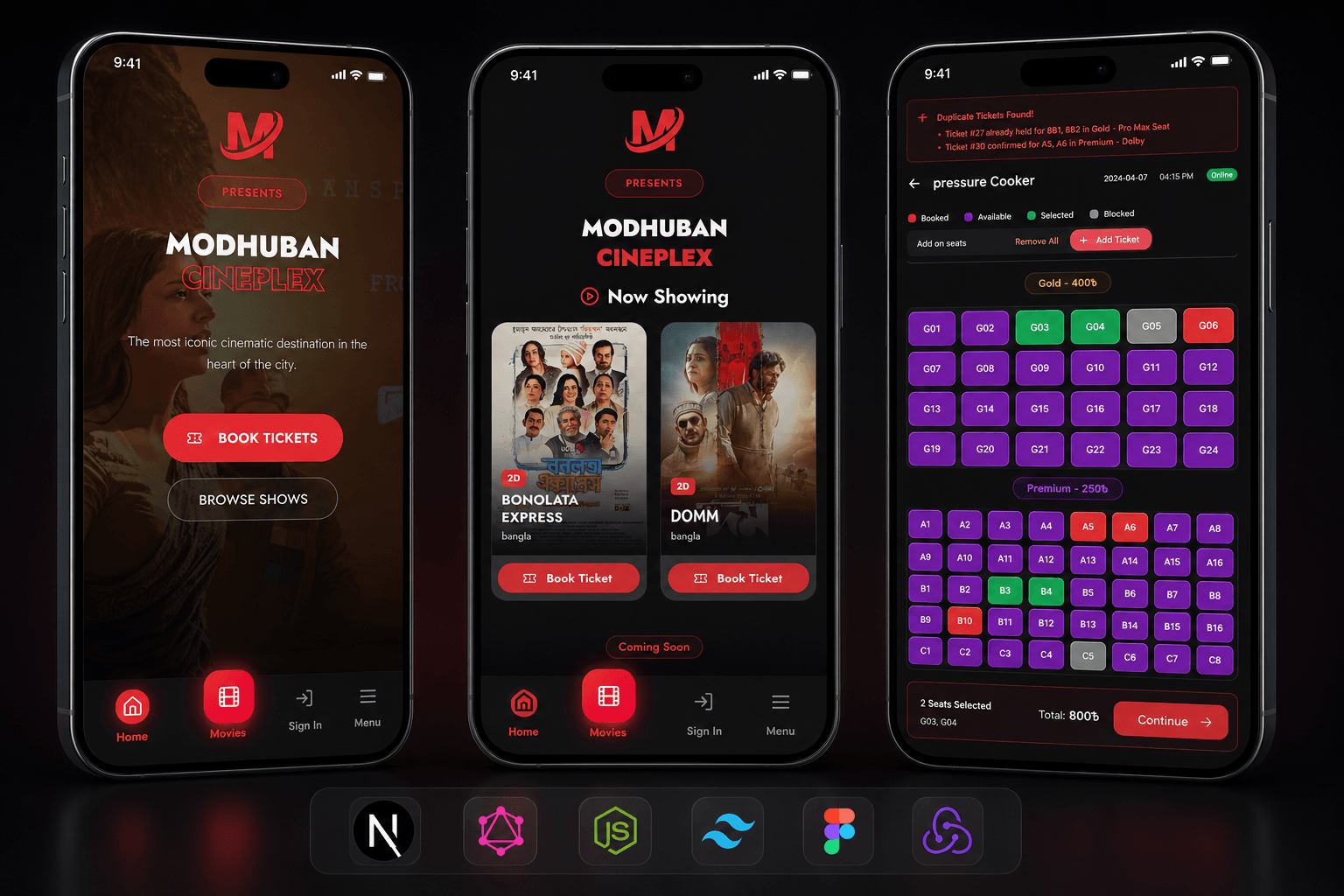
Modhuban Cineplex – Building an Enterprise-Grade Cinema Ticketing & Multiplex Operations Ecosystem
Executive Summary
Modhuban Cineplex (https://modhubancineplexbd.com/) is the premier cinema entertainment destination in Bogura, Bangladesh. To overcome severe box-office congestion, high-concurrency booking collisions, and legacy operational hurdles during major blockbuster releases, UpNovate engineered a robust, high-performance, full-stack digital ticketing platform and back-office cinema management engine.
The production system combines Next.js Server-Side Rendering (SSR), a high-throughput GraphQL API data layer, bidirectional WebSocket communication via Socket.io, passwordless phone OTP authentication via BulkSMSBD, and an enterprise multi-channel payment workflow powered by SSLCOMMERZ. Hosted on an optimized Linux VPS environment with custom Nginx reverse proxying and automated PM2 clustering, the platform handles massive traffic spikes with zero downtime and strict atomic seat-locking guarantees.
1. Project Background & Critical Operational Bottlenecks
Prior to designing this custom software architecture, Modhuban Cineplex operated primarily on physical counter sales and an unoptimized initial portal. During holiday releases and blockbuster premieres, the operation suffered from critical technical and architectural challenges:
- High-Concurrency Seat Clashing: Hundreds of users selecting the exact same seats at the same second led to database race conditions, locking bugs, and double-booked seats.
- Payment Dropped States & Webhook Loss: Network dropouts during third-party gateway redirects caused payment capture desynchronization where users were debited without receiving confirmed tickets.
- Gateway Rate-Limiting: High volume on initial direct merchant integrations triggered rate limits, requiring an immediate transition to a high-capacity SSLCOMMERZ infrastructure.
- Heavy Database Overheads: Monolithic REST endpoints frequently over-fetched relational theater metadata, slowing down API responses during peak concurrent traffic.
- Gate Verification Bottlenecks: Physical paper tearing and slow manual ticket lookups caused severe entry delays for audiences.
2. Strategic Engineering Objectives
To deliver an uninterrupted, modern digital experience, the UpNovate engineering team established six technical pillars:
- Low-Latency Data Delivery: Deploy GraphQL query schemas to fetch precise showtime, movie metadata, and seating availability in a single round-trip.
- Real-Time Seat Synchronization: Implement Socket.io WebSockets to broadcast live seat state changes across all active sessions with sub-second latency.
- Atomic Transaction Integrity: Implement an 8-minute temporary holding engine backed by distributed Redis locks to guarantee zero double-booking.
- Mobile-First Fast Authentication: Eliminate complex email registrations with instant SMS OTP login using the BulkSMSBD API.
- Automated Payment Reconciliation: Build asynchronous Server-to-Server IPN (Instant Payment Notification) listener micro-services handling instant rollbacks and idempotent ticket generations.
- Enterprise Production Infrastructure: Configure an AlmaLinux VPS environment with Nginx reverse proxy, gzip/Brotli compression, SSL/TLS hardening, and PM2 zero-downtime clustering.
3. Technology Architecture & Full Stack
| Architectural Layer | Core Technologies | Engineering Role & Capabilities |
|---|---|---|
| Frontend Application | Next.js, React, Tailwind CSS | Hybrid SSR/SSG pages, responsive interactive seat blueprint, dynamic client state |
| Data Query Layer | GraphQL (Apollo / Yoga) | Precision data fetching, schema-typed queries, reduced network payload sizes |
| Real-Time Communication | Socket.io (WebSockets) | Live bidirectional seat occupancy broadcasting (Available, Holding, Booked) |
| Backend & Core Services | Node.js, Express.js | High-throughput booking engine, OTP controllers, IPN webhook processors |
| Database & Caching | PostgreSQL, Redis | ACID-compliant relational booking ledger and low-latency distributed seat holding locks |
| SMS & Verification | BulkSMSBD Gateway, JWT | Automated OTP dispatch (<3s delivery) and encrypted user session tokens |
| Payment Gateway | SSLCOMMERZ Gateway | Multi-channel payments (bKash, Nagad, Rocket, Visa, Mastercard, Internet Banking) |
| Server & DevOps | AlmaLinux VPS, Nginx, PM2, Cloudflare | Reverse proxying, PM2 process management, automated SSL, and DDoS edge protection |
4. End-to-End System Workflow
The user booking and verification lifecycle executes through an integrated six-stage pipeline:
- Showtime & Hall Selection: User queries schedule and screen details via efficient GraphQL operations.
- Phone OTP Authentication: User inputs their mobile number; BulkSMSBD dispatches a 4-digit OTP; backend validates and returns an encrypted JWT session.
- Live Interactive Seat Map: Connected via Socket.io, the interactive seat blueprint reflects live availability. Selecting a seat immediately notifies all active clients.
- Distributed Holding Lock: Selected seats transition to an 8-minute temporary hold state in Redis, preventing race conditions while the user completes payment.
- SSLCOMMERZ Payment & IPN Handling: User completes payment across supported channels. The server receives an asynchronous IPN webhook to verify transaction signatures before finalizing state in PostgreSQL.
- Instant QR E-Ticket & SMS Confirmation: System immediately generates an encrypted QR pass on-screen and dispatches an automated SMS confirmation with a unique booking reference.
5. Major Engineering Challenges & Bug Fixes
During the continuous deployment and scale-up phases, several critical backend, network, and state management challenges were diagnosed and resolved:
A. Fixing Concurrency Race Conditions & Double Bookings
- The Challenge: Multiple users opening the seat layout simultaneously attempted to checkout the exact same prime seats, causing database integrity violations.
- The Fix: Architected an atomic locking mechanism using Redis TTL keys combined with PostgreSQL database transaction locks (
SELECT FOR UPDATE). When a user selects a seat, a distributed lock is acquired for 8 minutes; if checkout is abandoned, the lock auto-expires and notifies all connected clients via Socket.io.
B. Payment Gateway Transition & Asynchronous IPN Handling
- The Challenge: Initial direct bKash integration suffered from sporadic timeout drops and rate-limiting during blockbuster releases, occasionally leading to "paid but ticket not generated" states.
- The Fix: Rebuilt the checkout pipeline around SSLCOMMERZ, introducing an idempotent Server-to-Server IPN (Instant Payment Notification) listener. Even if a user closes their mobile browser during bank redirection, the background webhook captures the payment confirmation, securely issues the ticket, and delivers the SMS reference automatically.
C. VPS Performance Optimization & PM2 Process Clustering
- The Challenge: Sudden traffic surges caused CPU bottlenecks and single-thread Node.js event-loop blocking.
- The Fix: Deployed the backend using PM2 cluster mode across all CPU cores on the AlmaLinux VPS, backed by an optimized Nginx reverse proxy with dynamic caching headers, Brotli compression, and rate-limiting rules.
D. Eliminating API Over-Fetching with GraphQL
- The Challenge: Complex relational seat maps and movie schedules over REST resulted in heavy payload sizes that slowed down mobile booking performance on slower mobile networks.
- The Fix: Transitioned core booking and schedule modules to GraphQL, allowing client applications to query exact UI fields in single requests, reducing mobile network overhead by over 60%.
6. Core Administrative & Gate Operation Features
A. Centralized Multiplex Control Panel
- Dynamic scheduling engine allowing administrators to map showtimes, assign movie formats (2D/3D), and configure tiered pricing categories (Regular, Premium, VIP) in real time.
- Real-time box-office ledger tracking screen revenue, seat occupancy heatmaps, and concession analytics.
B. Instant QR-Code Entry Verification
- Dedicated gate scanner interface built for theater staff to scan customer mobile QR tickets using handheld devices or webcams.
- Sub-500ms validation verifying booking validity, showtime matching, and one-time entry redemption to prevent ticket duplication.
7. Measurable Impact & Business Outcomes
The digital transformation executed by UpNovate delivered immediate performance gains and revenue growth for Modhuban Cineplex:
| Key Performance Indicator | Legacy Operations | UpNovate Production Platform |
|---|---|---|
| Online Ticket Booking Share | 0% (Physical Counter Only) | Over 70% of Total Ticket Volume |
| Peak Concurrent Concurrency | Frequent Crashes During Premieres | 99.9% Uptime During Blockbuster Hits |
| Average Checkout Completion | 10–20 Minutes in Physical Queue | Under 45 Seconds via Mobile OTP |
| Seat Collision / Double Booking | Frequent Manual Slip Errors | 0% Double Booking (Zero Race Conditions) |
| API Network Payload Size | Heavy Monolithic Payloads | 60% Reduction via GraphQL Optimization |
| Entry Gate Verification Speed | Manual Paper Tearing | Under 1s QR Scanner Validation |
8. Summary & Continuous Innovation
The Modhuban Cineplex platform demonstrates how modern full-stack engineering—leveraging Next.js, GraphQL, Socket.io, and robust cloud infrastructure—can elevate regional entertainment operations into an automated, enterprise-level digital ecosystem. Ongoing development includes integrated snacks and concession pre-ordering, automated customer loyalty tiers, and automated WhatsApp ticket delivery.
Need a similar solution or custom engineering?
Let's discuss your architecture, tech stack, and deliverable timeline.