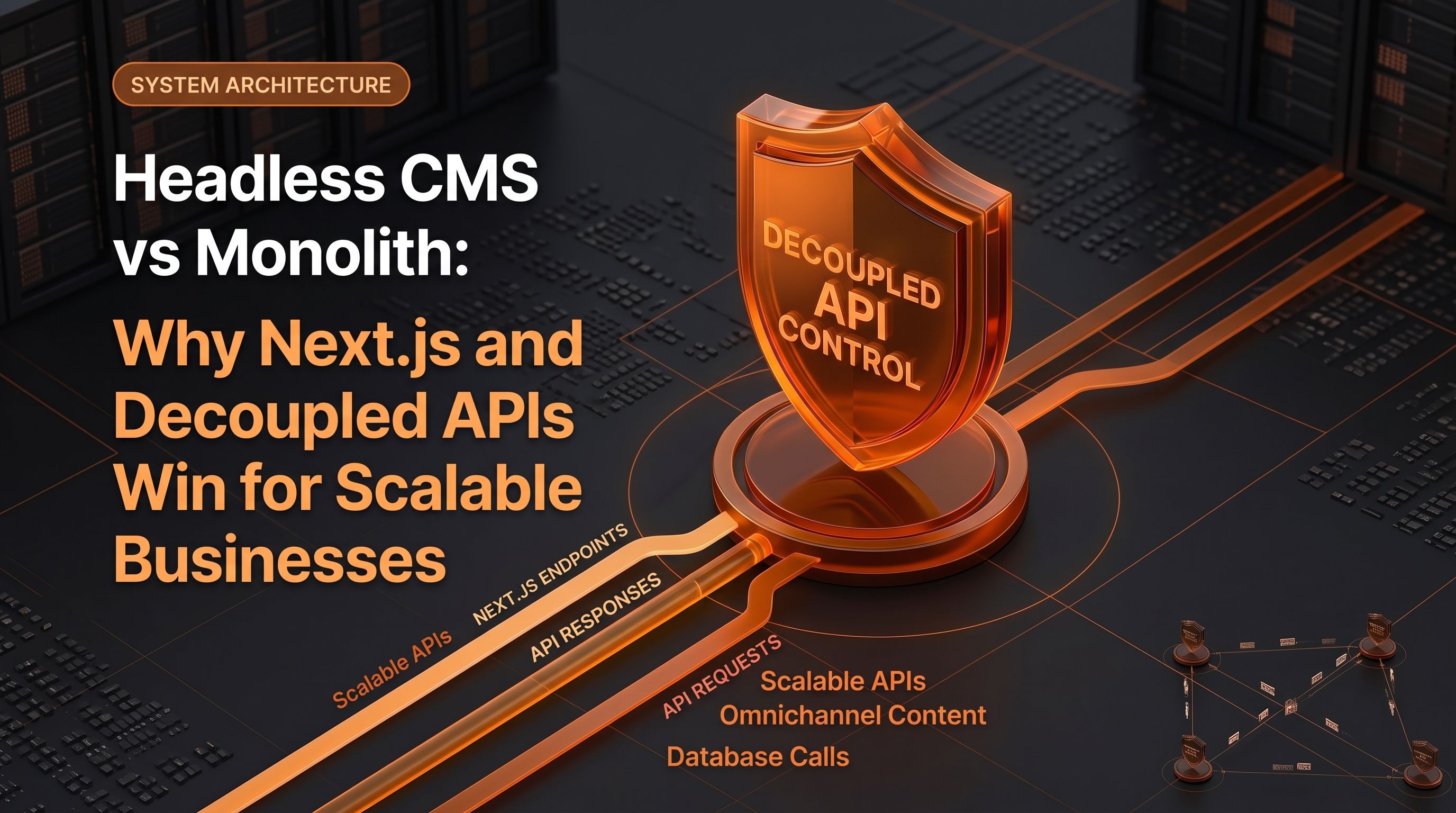
Headless CMS vs Monolith: Why Next.js and Decoupled APIs Win for Scalable Businesses
Introduction: The Architectural Evolution of the Web
For nearly two decades, monolithic Content Management Systems (like WordPress, Drupal, and Joomla) served as the default foundation for launching websites. They bundled the database, content authoring interface, business logic, and presentation templates into a single monolithic deployment unit.
However, modern digital business demands have drastically outgrown this coupled model. Today's commercial applications must deliver sub-second page loads across low-bandwidth mobile devices, serve content across multiple channels (web, iOS, Android, IoT, smart displays), and withstand massive traffic surges without degrading performance.
Modern software engineering has decisively shifted toward Headless Architecture—a paradigm where backend content management is decoupled from frontend presentation, communicating exclusively via structured JSON or GraphQL APIs.
1. The Core Bottlenecks of Monolithic Architectures
Monolithic systems rely on tightly integrated database-to-view lifecycles. When a user requests a URL, the server initiates a synchronous execution chain: booting database connectors, running internal plugins, evaluating theme logic, rendering PHP/HTML strings, and finally streaming the response. Under heavy traffic, this design creates critical operational bottlenecks:
- Server-Side Execution Overhead: Every page request triggers dynamic server-side computation. Even with local caching plugins, database connections saturate quickly during peak concurrency, degrading Time-to-First-Byte (TTFB) and triggering 504 Gateway Timeouts.
- Compromised Security Perimeter: In monolithic setups, the administrative login dashboard, database endpoints, and public-facing storefront share the exact same host. A single vulnerable plugin or unpatched dependency exposes the entire corporate database to SQL injection and remote code execution exploits.
- High Maintenance & Deployment Friction: Updating a simple UI component or refactoring a CSS layout requires testing, compiling, and deploying the entire monolithic application stack, slowing down product iteration cycles.
- Single-Platform Vendor Lock-in: Monoliths format data for web browser views (HTML), making it difficult and resource-heavy to syndicate the same content to native mobile applications, smart POS screens, or third-party partner portals.
2. Decoupled Next.js + Headless CMS Architecture
In a decoupled stack, content creation and content presentation operate as two isolated, purpose-built systems:
- The Headless CMS (Content Engine): Systems like Strapi serve exclusively as an administrative content management repository. Content creators write structured copy, configure taxonomies, and upload assets without worrying about visual layout rules. The CMS exposes this data via secure REST or GraphQL endpoints.
- The Next.js Frontend (Presentation Engine): A lightweight, dedicated frontend application queries the headless API, transforms data into modular React components, and renders optimized static HTML/Edge responses.
3. Deep Architectural Comparison
| Architectural Metric | Traditional Monolith (e.g., WordPress) | Decoupled Next.js + Headless API |
|---|---|---|
| Rendering Strategy | Dynamic Server-Side HTML Rendering | Hybrid ISR (Incremental Static Regeneration), SSG & SSR |
| Page Load Velocity | 2.5s – 5.0s Average (Plugin-Dependent) | Sub-Second Performance (< 800ms Globally) |
| Core Web Vitals | Frequent Layout Shifts & Render-Blocking Assets | 95+ Baseline Performance Index across Mobile/Desktop |
| Security Architecture | Shared Attack Surface (Admin & Public on Same Host) | Isolated Admin; Edge CDN Serves Static Pre-Rendered Pages |
| Scalability Cost | Requires Scaling Heavy VPS/Dedicated Servers | Static Pages Scale Infinitely via Edge CDNs at Low Cost |
| Omnichannel Reach | HTML Output Restricted Primarily to Web | Structured JSON/GraphQL Distributed across Web, iOS, Android |
4. Engineering Advantages of the Decoupled Stack
A. Sub-Second Performance via Incremental Static Regeneration (ISR)
Next.js revolutionizes content delivery by combining the raw speed of static websites with the flexibility of dynamic databases:
- Build-Time Static Generation (SSG): High-traffic marketing pages, case study directories, and blog posts pre-render into pure HTML and JSON at build time.
- On-Demand Background Revalidation: When an editor updates content in the CMS, a webhook triggers Next.js On-Demand Revalidation. The system regenerates only that specific page in the background in milliseconds without requiring a full site rebuild.
B. Hardware-Grade Edge Security
Because end-users interact solely with static assets distributed across Edge CDN servers (Cloudflare/Vercel), your primary database and headless CMS administrative panels remain completely hidden behind private network firewalls. Attackers have no direct database endpoints or PHP interpreters to exploit.
C. Developer Agility & Clean Design Systems
Frontend engineers are free from rigid CMS templating constraints. Teams can build custom UI libraries using React, TypeScript, and Tailwind CSS, implement robust component testing, and integrate modern animation frameworks without fighting legacy theme stylesheets.
D. True Omnichannel Content Distribution
A single headless CMS entry functions as a unified source of truth. The exact same API payload that powers your Next.js web application can instantly feed:
- Native Mobile Apps (React Native, Flutter, Swift)
- E-Commerce Micro-Frontends & Point-of-Sale Displays
- Partner syndication feeds and automated email marketing newsletters
5. Architectural Implementation Pipeline
Implementing a modern decoupled stack follows an event-driven four-step pipeline:
- Content Ingestion & Modeling: Editors author structured data inside the isolated Strapi CMS instance.
- Secure API Transmission: The Next.js presentation engine fetches clean JSON/GraphQL payloads over authenticated endpoints.
- Event-Driven Webhooks: Content updates inside the CMS trigger background On-Demand Revalidation webhooks on the server.
- Global Edge Caching: Updated pages distribute instantly across Cloudflare/Vercel Edge CDN nodes worldwide for instant end-user delivery.
6. Summary: When Should You Make the Switch?
Transitioning from a traditional monolithic CMS to a decoupled Next.js architecture is recommended if:
- Your digital business relies heavily on organic search traffic (SEO) and requires pristine Core Web Vitals.
- Your application experiences high-concurrency traffic spikes that cause monolithic servers to slow down or crash.
- You manage multi-channel digital products requiring unified content delivery across web and mobile platforms.
- Your organization prioritizes enterprise data security and requires strict isolation between administrative portals and public interfaces.